Guide technique Karlead : spécifications produit, normes de prise, conformité à l'import, transport des batteries et planification des coûts. Les références de normes restent en notation internationale. Pour confirmer modèle, MOQ et devis pour votre marché : sales@karlead.com.
Connaissance produit9 min readPublished 2026-11-13Par l'équipe achats de Karlead
Portable tire inflator specs: how to read PSI, inflation time and auto-stop
Almost every portable inflator in a catalogue claims the same maximum pressure. The difference shows up in how long it takes to get there, how many tyres it can finish on one charge, and whether the cut-off stops at the pressure printed on the display. Those are the three numbers worth putting into a purchase order.
La réponse courte
Maximum PSI is a ceiling, not a speed. Insist on inflation time quoted against a named reference tyre and a starting pressure.
Cylinder diameter, battery capacity and duty cycle together determine how many tyres a unit finishes before it needs a rest or a recharge.
Auto-stop accuracy is a test result, not a feature list item. Check it against a calibrated gauge on the incoming sample.
Compare carton quantity and gross weight as well as unit price: they change the landed cost per retail unit.
The four numbers on an inflator data sheet
Ligne de spécifications
What it tells you
What it does not tell you
Plage de pression
The working window of the pump and the gauge units offered
How fast it reaches the target, or how accurately it stops
Temps de gonflage
Time to inflate a named reference tyre under stated conditions
What happens on a larger tyre, or after the unit is warm
Diamètre du cylindre
A proxy for air volume per stroke
Real airflow, which also depends on motor speed and gearing
Capacité de la batterie or supply
Whether the unit is cordless, DC12V, or part of a multi-function unit
How many tyres remain after the first one
A data sheet with only a pressure range and a photo is a consumer listing, not a sourcing specification.
Temps de gonflage is meaningless without the reference tyre
Our AC-001 data sheet states 9 min 30 s for a 195/65/R15 car tyre, with 1.5 tyres per charge and a 17 mm cylinder. AC-6188 lists 5 min for the same reference tyre with a 22 mm cylinder. Those two lines are comparable because the reference tyre is named. A claim of "fast inflation" with no reference tyre is not comparable with anything.
Modèle
Plage de pression
Cylinder
Temps de gonflage (195/65/R15)
Tyres per charge
Power
AC-001
3-150 PSI / 0.2-10.3 BAR
17 mm
9 min 30 s
1.5
7.4 V lithium, 2000 mAh x 2
AC-0013
3-150 PSI / 0.2-10.3 BAR
17 mm
9 min 30 s
1.5
7.4 V lithium, 2000 mAh x 2
AC-6188
3-150 PSI / 0.2-10.3 BAR
22 mm
5 min
Listed on the model sheet
DC12V in-car / 11.1 V battery version
AC-2001
3-150 PSI / 0.2-10.3 BAR
19 mm
8 min
3
14.8 V jump starter, 2000 mAh x 4
Catalogue values from the model data sheets. Always confirm the current revision with the quotation, because packaging and battery versions change.
Auto-stop accuracy, gauge units and the display
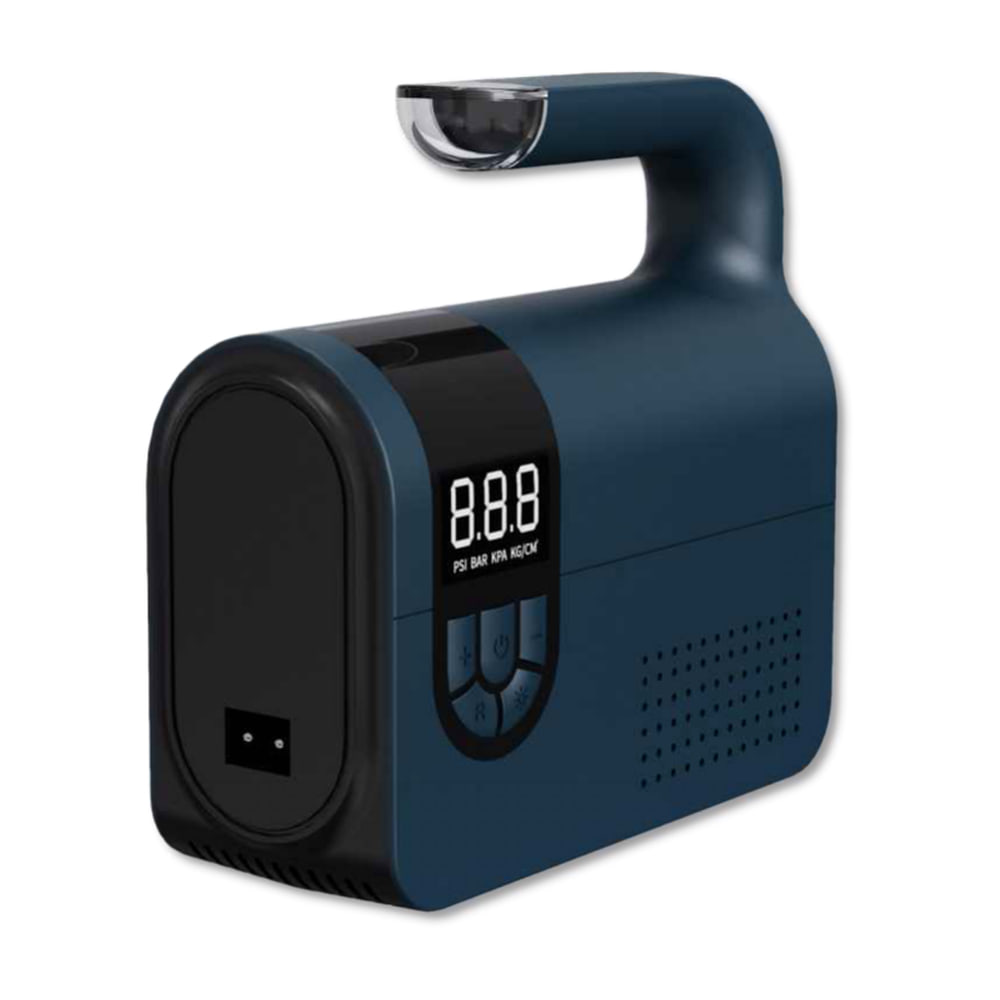
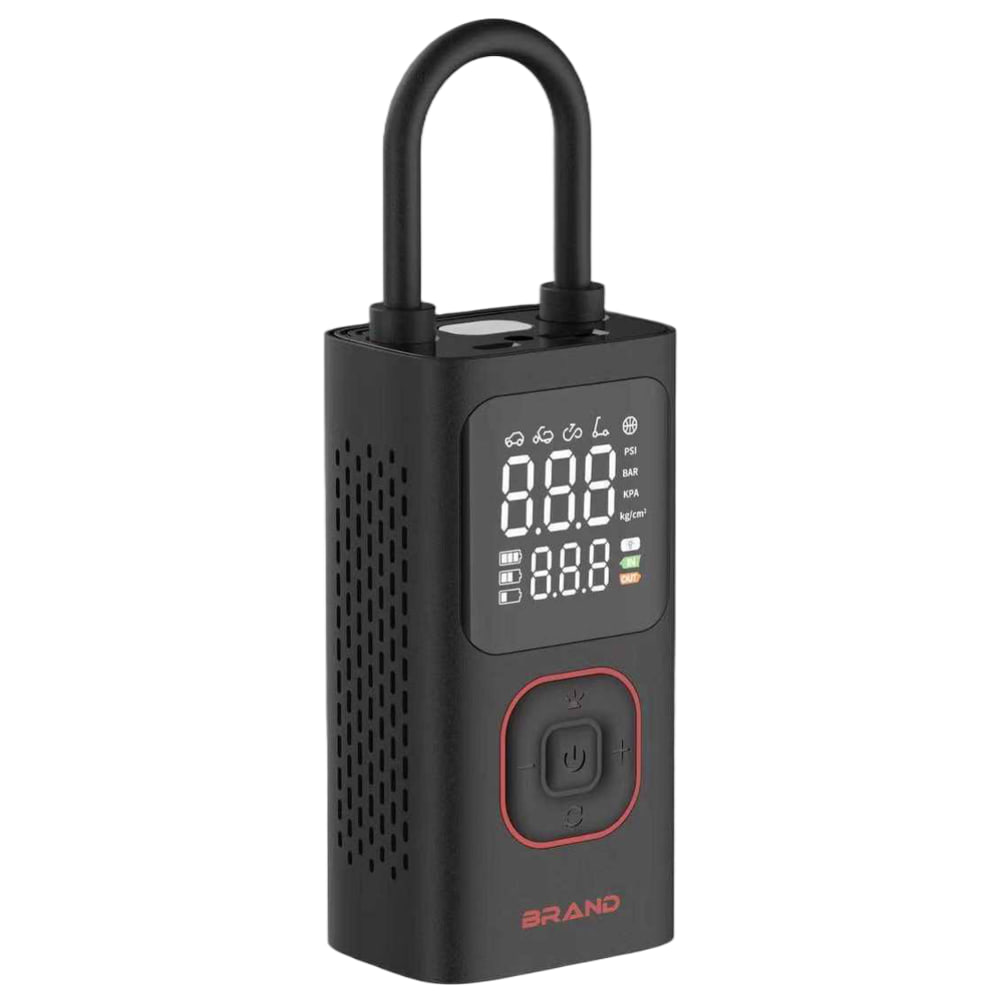
Our AC-001 and AC-0013 sheets list PSI, BAR, KPA and Kg/cm² as selectable units. Confirm which unit is the default at power-on for your market, and whether the manual explains the others.
Test the cut-off against a calibrated gauge at three targets: low, mid and near the top of the range. Record the deviation, not just a pass or fail.
Check what happens when the target is reached while the hose is still attached, and whether the unit resumes automatically if pressure falls.
Ask whether the pressure sensor is a separate component with its own calibration record, and how a drift is corrected in a production run.
Lithium, DC12V or a jump-starter combination
Power architecture
Best fit
Buyer check
7.4 V lithium, cordless
Retail, e-commerce, emergency kits, bicycle and motorcycle use
Real tyres per charge, charging connector, lithium transport documents
DC12V in-car
Workshop, fleet, drivers who keep the engine running
Cable length, fuse, current draw, behaviour at low battery voltage
Jump starter with built-in compressor
Premium roadside bundles and multi-function displays
Compressor tested separately from cranking; heat after repeated use
The best-selling configuration in a short-form video is often the cordless one; the best-selling configuration in a workshop catalogue is often the DC12V one. Pick for the channel.
Noise, heat and duty cycle: the test a data sheet omits
A small compressor gets hot. What matters commercially is whether the unit finishes a second tyre without a thermal cut-out, and what the user hears while it does. Neither appears in a four-line parameter sheet, so both belong in your sample protocol.
Inflate the reference tyre from the stated starting pressure and log the time, the final pressure and the housing temperature.
Immediately repeat on a second tyre and log whether a thermal cut-out interrupts the run.
Measure noise at a fixed distance with the unit on a hard surface and on a carpet, because retail complaints often come from the hard-surface case.
Cycle the unit through the agreed number of charge and discharge rounds, then repeat the first test and compare the times.
Carton maths that changes the landed cost
Modèle
Poids net
Colour box
Pcs per carton
Dimensions du carton
Poids du carton
AC-001
0.41 kg
90 x 72 x 148 mm
24
38 x 23 x 31.5 cm
13 kg
AC-0013
0.395 kg
93 x 74 x 157 mm
24
30.7 x 29.5 x 35.3 cm
13.5 kg
Two units with nearly identical performance figures pack differently. Model the freight on the carton, not on the unit.
What to put in the RFQ
The exact pressure range and available gauge units, with the default unit for your market.
Temps de gonflage and tyres per charge tied to a named reference tyre and starting pressure.
Cylinder diameter, motor type, hose length, nozzle set and included adapters.
Auto-stop tolerance at three target pressures, measured against a calibrated gauge.
Batterie version, charging connector, carton quantity and carton dimensions.
Manual language, artwork version and the test record that ships with the order.
If you plan to advertise a "150 PSI" inflator, confirm that the claimed maximum is a working range with an auto-stop target, not an unreachable ceiling. Retailers ask for the same evidence you should be asking for.
Questions fréquentes
Quelles sont les caractéristiques principales du ce modèle ?
La fiche technique du ce modèle figure dans le tableau de paramètres de cette page. Confirmez prise, tension, capacité et emballage par écrit avant commande.
Le ce modèle accepte-t-il un logo et un emballage personnalisés ?
Oui. Impression du logo, couleur du boîtier, visuel de la boîte, langue du manuel et norme de prise peuvent être définis sur les moules existants, avec un MOQ par configuration.
Quels sont le MOQ et le délai du ce modèle ?
Le MOQ est coté par modèle et varie selon la couleur, la prise et l'emballage. Envoyez la quantité et le marché pour recevoir prix unitaire, MOQ et délai par écrit.
Puis-je recevoir des échantillons du ce modèle avant commande ?
Oui. Des échantillons des modèles listés sont disponibles sur demande ; les échantillons de pré-production sont soumis à votre approbation écrite avant la production en série.
Quelles options de prise et de tension pour le ce modèle ?
La norme de prise et la tension sont définies par marché (UK, US, AU, UE, Brésil NBR 14136, etc.). Indiquez le pays de destination pour fixer la bonne configuration.
Comment demander un devis pour le ce modèle ?
Envoyez un e-mail à sales@karlead.com avec la référence, le marché, la norme de prise et la quantité. Réponse sous un jour ouvré avec prix, MOQ, délai et données d'emballage.
Quelles normes de prise et tensions sont disponibles ?
UK, US, AU, UE et Brésil (NBR 14136) selon le marché, ainsi que 127 V / 220 V. Indiquez le pays de destination pour figer la configuration avant production.
Comment sont définis le MOQ et l'emballage d'export ?
Le MOQ et le nombre de pièces par carton sont indiqués par modèle sur la fiche technique. Cartons d'exportation ou emballage retail personnalisé sont convenus par écrit, avec traçabilité des lots.