Why the biggest number on the box is the wrong first question
A booster is a battery, a switch, a cable and a clamp. The headline figure is normally the highest current the pack can deliver for a very short pulse in a laboratory condition. It is a useful ceiling, not a promise about a cold diesel engine at seven in the morning. What actually turns the starter motor is sustained current delivered through the cable and clamp without a large voltage drop.
Two quotations that share the same headline number can therefore behave very differently. One may use a heavier cable and a plated clamp; the other may use a thin lead and a light spring. The difference costs money, so it is the first thing trimmed when a buyer negotiates only on unit price.
Courant de crête versus instant starting amps
| Ligne de spécifications | What it actually describes | What to ask the supplier |
|---|---|---|
| Courant de crête | A short-duration maximum under the test condition chosen for the data sheet | How long was the pulse, at what state of charge and what temperature? |
| Instant starting amps | The current available to crank an engine, sustained long enough to matter | Which engine and which battery state of charge was used for this figure? |
| Capacité de la batterie (Ah) | Stored energy, which governs how many attempts are possible before recharging | What is the capacity after a full recharge cycle, and how many starts per charge? |
| Engine coverage claim | A marketing summary of the vehicle range intended | Ask for the test matrix behind the claim, not the claim itself |
| Operating temperature | The range in which the published figures were measured | Request low-temperature discharge data if your market has cold winters |
The practical check is to ask for the two numbers side by side and then ask what separates them. A supplier who can explain the test condition, the cable gauge and the state of charge is reading a real data sheet. A supplier who repeats the marketing figure is reading the carton.
What the data sheets in this catalogue actually list
Our own published parameters make the distinction visible. These are catalogue values, not a performance promise for your market, and they show why two similar-looking units belong in different price tiers.
| Modèle | Batterie | Courant de crête | Instant starting amps | Other built-in function |
|---|---|---|---|---|
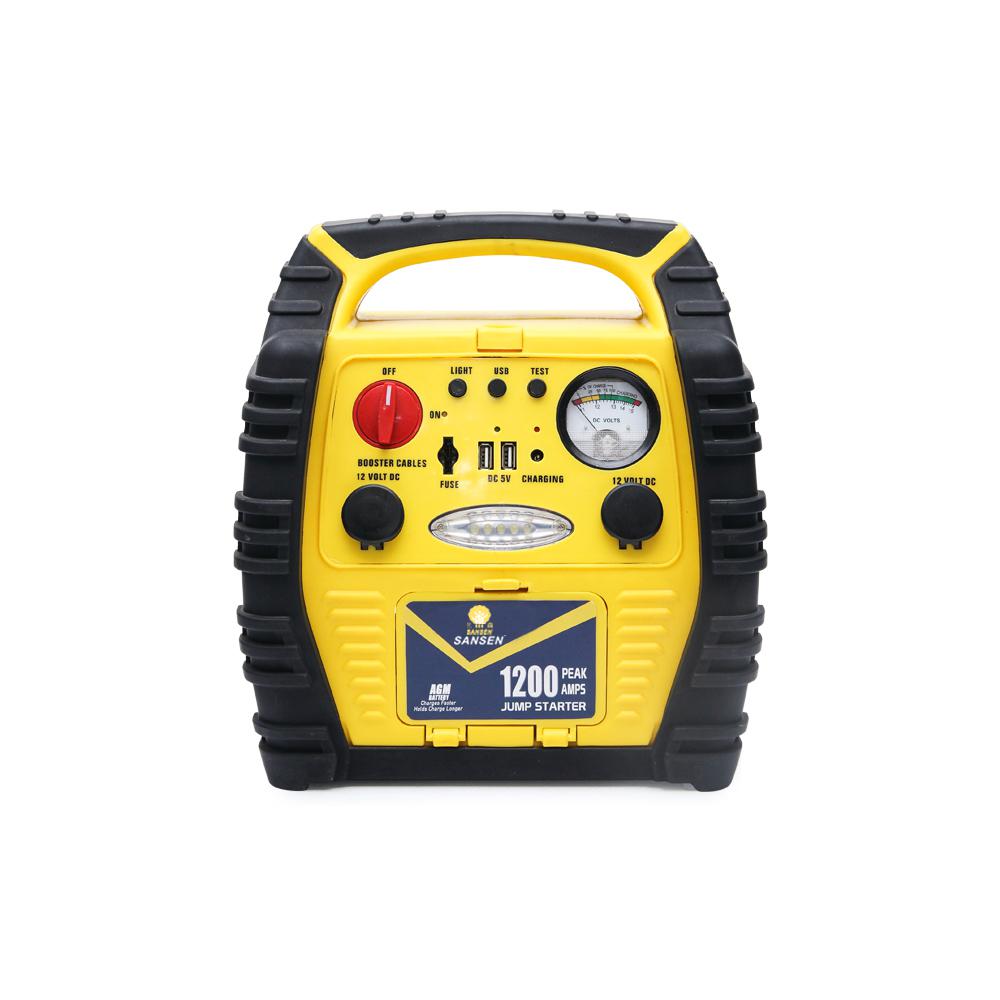
| AC0903 | 12 V 17 Ah rechargeable lead-acid | 1200 | 400 | USB ports, LED work light, reverse-connection and short protection |
| AC0901 | 12 V 17 Ah rechargeable lead-acid | 1200 | 400 | Adds a built-in 150 PSI air compressor and AC output |
| AC55000 | 12 V 7 Ah rechargeable lead-acid | 600 | 230 | USB port, LED work light, reverse-connection and short protection |
Lead-acid pack or lithium pack: the trade-off is logistics as much as performance
| Factor | Sealed lead-acid pack | Lithium pack |
|---|---|---|
| Weight and size | Heavier for the same stored energy | Lighter and easier to merchandise as a glove-box item |
| Cold behaviour | Capacity falls in deep cold but recovers | Also falls in cold; ask for discharge curves at your temperature range |
| Storage | Tolerates being left on a charger; dislikes deep discharge | Holds charge well but needs a defined storage state of charge |
| Transport | Generally simpler documentation | Triggers lithium battery documentation for air and many sea routes |
| Typical channel | Workshop, roadside, fleet and multi-function units | Consumer retail, e-commerce, compact emergency kits |
Clamps, cable and the protection circuit
- Ask for the cable gauge and length in millimetres, plus whether the conductor is copper or copper-clad aluminium. Short, thin cable is the cheapest way to erase a good battery specification.
- Check the clamp jaw: full copper contact, spring force, and insulation over the whole handle. Photograph both sides on the sample.
- Verify reverse-connection protection on a bench with a deliberately reversed connection, and record what the unit does. The data sheets for AC0903 and AC55000 both list reverse-connection, overload and short protection as built-in functions; the test should still be run on the incoming sample.
- Ask whether the USB ports, LED work light and compressor (where fitted) are fused independently of the cranking path.
A repeatable sample test you can run in an afternoon
| Test | Method on the sample | Pass signal |
|---|---|---|
| Charge and hold | Full charge, then leave for the agreed storage period | Unit still starts the reference vehicle on the first attempt |
| Cold start trial | Condition the unit at the lowest temperature your market sees | Record attempt count and voltage sag, not just a yes or no |
| Reversed clamp | Connect to a test battery the wrong way round | No current flows, no damage, clear indication to the user |
| Repeated attempts | Several cranking attempts in short succession | Cable and clamp stay cool enough to handle, no reset needed |
| Compressor, if fitted | Inflate a reference tyre from a defined pressure | Time and cut-off accuracy match the published claim |
Writing the specification into the purchase order
- Modèle number and battery chemistry with capacity, exactly as on the approved data sheet.
- Peak and instant starting amps, both figures, plus the engine coverage claim you agreed to.
- Cable gauge and length, clamp type, and the list of built-in functions.
- Protection functions that must be present, and the test record that must accompany the shipment.
- Manual language, carton markings, barcode and the version of the artwork.
- The golden sample reference: a sealed, dated unit held by both sides.
Where this leaves the quoting conversation
Send the same five-line RFQ to every shortlisted supplier, ask each one to identify assumptions and exclusions, and compare the answers rather than the headline amp figure. A supplier who notices that a compact housing cannot support the sustained current you asked for is telling you something useful. A supplier who agrees to everything without a question is quoting a carton, not a product.