Brushed or brushless: the first fork in the road
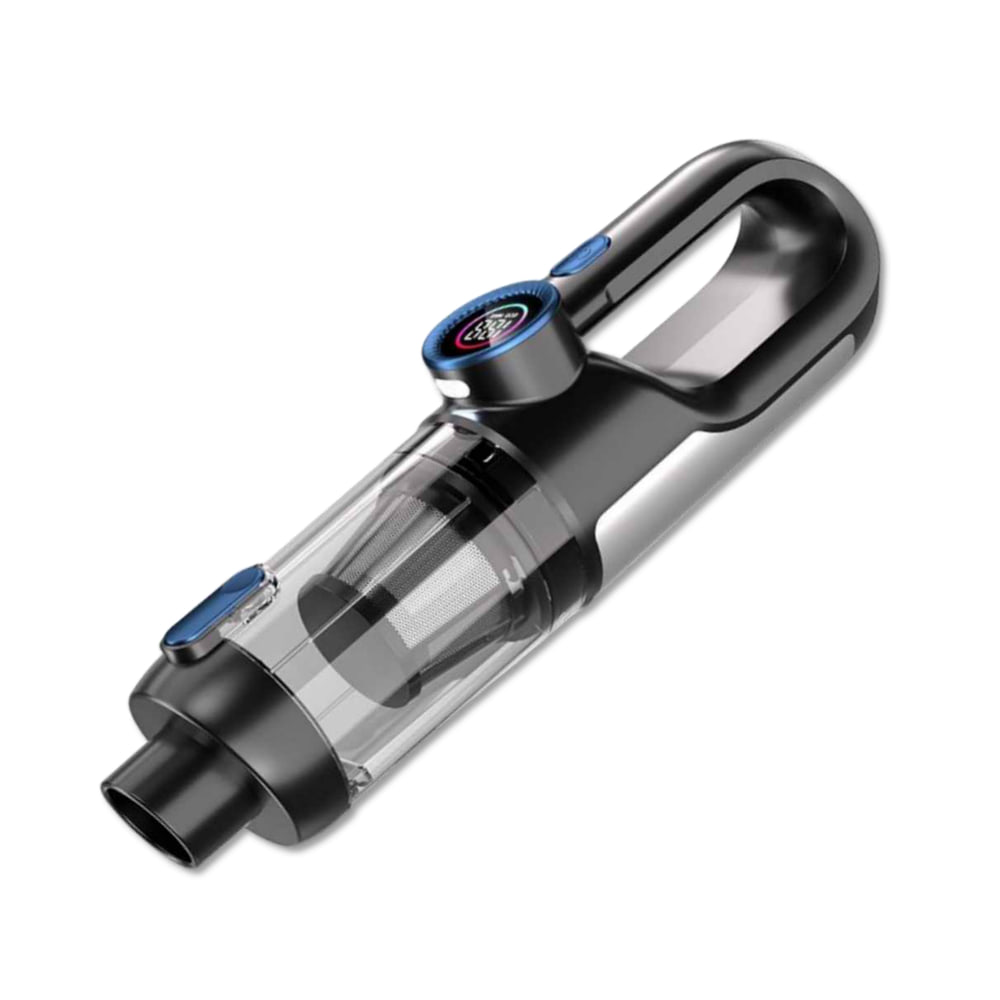
Small handheld vacuums use either a brushed DC motor or a brushless motor. Brushed motors are cheaper and have been in production for decades, which makes them the default at entry price points. Brushless motors cost more per unit but run cooler, last longer on the same battery and are noticeably quieter at equivalent suction. For a retail program above the entry tier, brushless is what the specification should say — in writing, because the two look identical from the outside.
The catalogue illustrates the range: AC-2466 is offered in a brushed version at 5,000 Pa and a brushless version at 13,000 Pa in the same 7.4 V platform, while AC-1001 runs a brushless motor on an 11.1 V battery with a two-gear selector — 10 kPa on standard and 17 kPa on boost. Same category, three different product realities.
Reading suction numbers that mean something
Suction is quoted in kPa (kilopascals) or Pa. Two rules make the figures comparable. First, compare at the same measurement point: suction at the motor housing is always higher than suction at the nozzle end of the hose, and the honest figure is the one the buyer experiences. Second, compare on the same gear: a two-gear unit quoting only the boost figure is quoting its worst-case runtime mode.
| Modèle | Motor | Rated voltage | Suction | Poids net |
|---|---|---|---|---|
| AC-1001 | Brushless | 11.1 V (lithium) | 10 kPa standard / 17 kPa boost | 0.63 kg |
| AC-2466 (brushed) | Brushed | 7.4 V | 5,000 Pa | 0.34 kg |
| AC-2466 (brushless) | Brushless | 7.4 V | 13,000 Pa | 0.36 kg |
| AC-2166 | Brushed | DC 12 V in-vehicle / 7.4 V lithium | 5,000 Pa | 0.713 / 0.716 kg |
Filtration: where cheap units give up
A vacuum loses suction as its filter loads with dust. The filter stack is therefore a better predictor of long-term performance than the day-one kPa figure. Look for three things: a cyclone or mesh pre-filter that lets coarse debris drop out of the airstream, a main filter rated HEPA-style for fine dust, and a washable construction, because a filter the buyer cannot clean is a filter that quietly kills the product at month three.
Ask the supplier to state the filtration stages and whether the main filter is washable. If the answer is "one filter, yes washable" at a boost-mode price, expect the suction curve to fall faster than the datasheet implies.
Power source: three products wearing one name
- Cordless lithium models (7.4 V or 11.1 V packs): sell on convenience, carry lithium transport rules, need a charging method in the box — AC-1001 uses USB-C fast charging.
- In-vehicle 12 V models: plug into the cigarette socket, lowest cost, but run only while driving and are limited by socket fuse rating.
- Dual-source models: AC-2166 ships in an in-vehicle version and a lithium-battery version on the same platform, which lets a distributor serve both channels without two supply chains.
Decide the channel first — retail shelf, marketplace, workshop or fleet — and let the channel pick the power source. Ordering a cordless unit for a workshop channel, or a 12 V unit for retail gifting, is a specification error no factory can fix in production.
Accessory kit and packing: the unglamorous margin
The accessory kit is where quotations quietly diverge. A complete kit — crevice tool, brush nozzle, extension hose and a washable filter — adds cost but is the difference between a five-star and a three-star review. Check the packed reach: a hose plus wand that reaches the boot of a sedan needs roughly a metre and a half of working length, and a shorter kit gets used once and retired to the glovebox.
Packing math also differs by model: AC-1001 packs 12 pcs per 52.5 × 35 × 35 cm carton at 14 kg gross, AC-2466 packs 30 pcs per carton at 15 kg. Compute the container fill per model before you commit the split — the lighter carton is not automatically the cheaper freight.
Quality gates for the purchase order
- 100% run test: every unit switched on, run and checked for abnormal noise before packing — a bearing fault is audible in the first ten seconds.
- Suction sampling: a gauge check on a sample of units per lot against the quoted kPa, at the nozzle, on the quoted gear.
- Filter fit check: correct filter installed and seated, since filter variants ship loose and are a known assembly error.
- Carton drop test: vacuums are dense goods; a recorded drop test protects the lithium pack and the housing joints.
- Accessory completeness count: a missing crevice tool in a sealed retail box is a marketplace return even when the vacuum is perfect.